Public vs Private Trackers: What’s the Difference? (2026)
On this page ▾
Torrenting isn’t one thing. Behind every download you’re actually choosing between two very different worlds: public trackers, which are open to anyone, and private trackers, which are invite-only communities with rules. New users almost always start on public trackers without realizing there’s an alternative, and later discover that the frustrations they’ve been living with — dead torrents, fake files, slow speeds — are mostly solved on the private side. This guide explains exactly how the two differ, what “ratio” means and why it matters, and where a seedbox fits in. If you’re brand new, the beginner’s guide to seedboxes is a good companion read.
What Are Public Trackers?
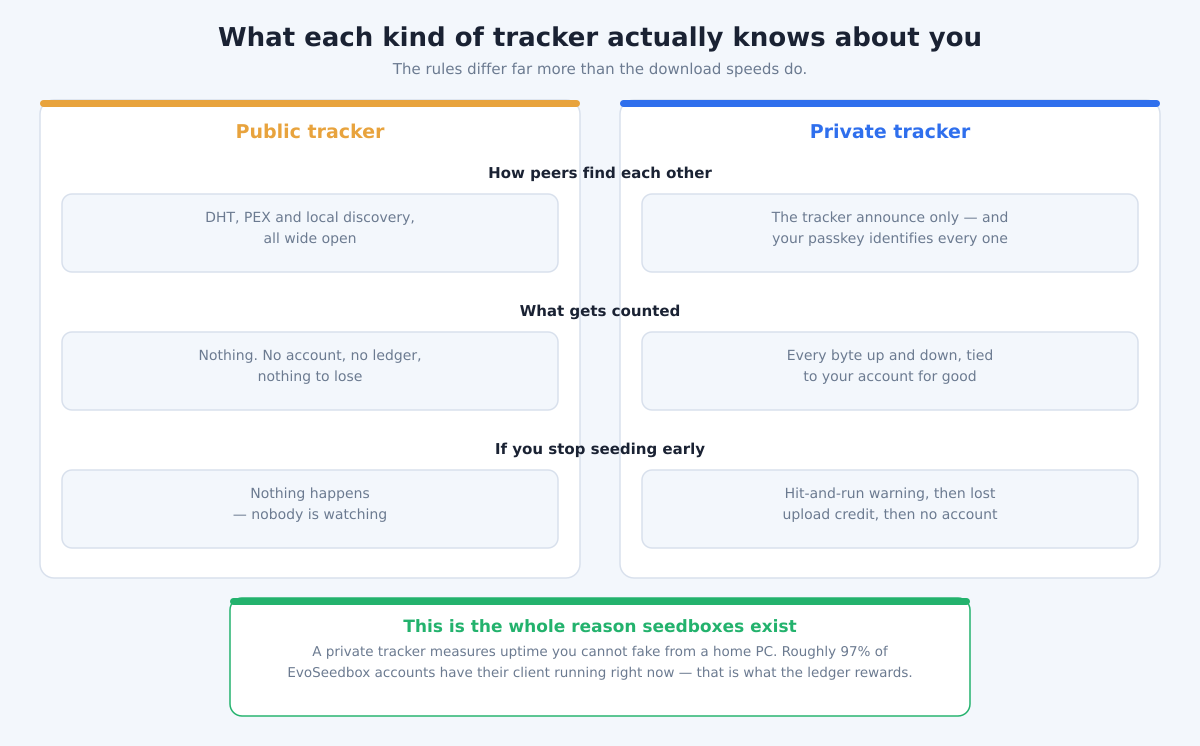
A public tracker is an open indexer — anyone can browse it, grab a magnet link, and start downloading. No account, no approval, no obligations. Public torrents also lean heavily on DHT (Distributed Hash Table) and PEX (Peer Exchange), decentralized systems that let clients find peers without a central server at all. This is the torrenting most people know: search a site, click, download.
The upside is obvious — zero friction and an enormous catalog of mainstream movies, TV, music, and software. If content is popular, you’ll find it on a public tracker within minutes of release.
Public Tracker Pros
- No barrier to entry — no account or invite needed.
- Huge selection of popular, mainstream content.
- No obligations — download and leave, nobody tracks your behavior.
Public Tracker Cons
- Inconsistent quality — releases are unvetted; you’ll find mislabeled files, wrong resolutions, and bad encodes.
- Higher risk of fakes and malware, especially in software and “too good to be true” releases.
- Poor retention — once a torrent stops being popular, seeders vanish and it dies. Older or niche content is often undownloadable.
- No ratio rules, which sounds nice but means most people never seed — so the swarm collapses fast.
- This is where copyright monitoring happens. Because public swarms are open and DHT-based, anti-piracy agencies simply join them and log every IP they see. Open swarms are the easiest place in the world to be observed.
What Are Private Trackers?
A private tracker is a closed, invite-only community. You need an account to get in, and getting that account usually means an invitation from an existing member, an interview on an IRC channel, or an open-signup window you have to catch. Once inside, the tracker manages the entire swarm centrally — there’s no public DHT, and members are required to keep DHT and PEX turned off. Peers are known and accountable.
The defining rule of private trackers is ratio.
Understanding Ratio
Your ratio is simply the amount you’ve uploaded divided by the amount you’ve downloaded. Download a 10 GB file and upload 10 GB back to other members, and your ratio is 1.0. Most private trackers require you to maintain a minimum ratio (often around 1.0, sometimes lower) or meet a minimum seeding time on each torrent. The logic is fair: a tracker only stays healthy if the people taking content also give it back. If your ratio drops too low, you can be warned, throttled, or lose your account entirely.
This is the single biggest adjustment for people coming from public trackers. On a public tracker you can download and immediately close your client. On a private tracker, that behavior gets you banned. You are expected to seed.
Private Tracker Pros
- Higher, curated quality — releases are vetted against strict standards, so you get exactly the encode you expect.
- Excellent retention — because members must seed, torrents from years ago are still alive. Niche and archival content survives.
- Stronger community — forums, requests, and knowledgeable staff.
- Far less monitoring exposure — no open DHT and a closed membership means random agencies aren’t sitting in the swarm logging IPs.
Private Tracker Cons
- Hard to get in — invites are scarce and open signups are rare.
- Ratio pressure — you have to actively maintain your upload, which takes bandwidth and uptime.
- Strict rules — DHT/PEX must be off, no ratio cheating, no account sharing. Break them and you’re gone.
- Losing access — let your ratio slide or go inactive and you can lose an account that took months to earn.
Public vs Private Trackers: Side by Side
| Factor | Public Trackers | Private Trackers |
|---|---|---|
| Access | Open to anyone | Invite-only / account required |
| Ratio rules | None | Enforced — you must seed |
| DHT / PEX | On (relied upon) | Must be OFF |
| Content quality | Inconsistent, unvetted | Curated, standardized |
| Retention (old torrents) | Poor — torrents die | Excellent — long-lived seeds |
| Malware / fakes risk | Higher | Lower (moderated) |
| Monitoring exposure | High — open swarms are watched | Lower — closed, no public DHT |
| Selection | Huge, mainstream | Deep, including niche/archival |
| Best for | Beginners, casual use | Serious, long-term collectors |
Which Should You Use?
Most people start on public trackers, and that’s fine — it’s the natural on-ramp. You learn how a torrent client works, you get the content you want, and you don’t have to earn your way into anything. If you download occasionally and stick to popular content, public trackers may be all you ever need.
Serious users almost always migrate to private trackers over time. The pull is quality and permanence: you stop fighting dead torrents, you stop second-guessing whether a file is real, and you get access to content that simply doesn’t exist in living form on public swarms. The trade-off is responsibility — you have to seed and keep your ratio healthy. That’s exactly where the tooling starts to matter.
One important honesty check: private trackers are not “more legal.” The copyright status of a file is identical no matter where you get it — a private community doesn’t change what the content is. What changes is your exposure: closed swarms without public DHT are far less monitored than open ones. That’s a privacy difference, not a legal one. Understand the rules where you live before you torrent anything — see our overview of whether torrenting and seeding are legal in 2026.
Why a Seedbox Matters for Private Trackers
Here’s the practical problem private trackers create: to keep your account, you have to seed, and to seed you need your client online, uploading, around the clock. Doing that from a home PC means leaving it powered on 24/7, burning your home upload bandwidth, and putting your home IP directly into every swarm. Most home connections also have weak upload speeds, so building ratio is painfully slow.
A seedbox solves all of this. It’s a remote server that runs your torrent client 24/7 on a fast datacenter line — often 1 Gbps or more. Because it seeds continuously at high speed, it builds ratio quickly and keeps your torrents alive long after a home connection would have gone to sleep. Your home IP never touches the swarm; only the seedbox’s IP is visible. This is why a seedbox is the standard, expected tool among private-tracker users, and why serious “racers” — people competing to be the first seeder on new uploads for maximum ratio gain — rely on them. If speed is your goal, see the best seedbox for racing.
A good seedbox also makes it easy to respect private-tracker rules. You can keep DHT and PEX disabled in your client — a hard requirement on nearly every private tracker — set proper seeding limits, and manage everything through a clean web interface. If you’re new to the client, our ruTorrent getting-started guide walks through the settings. We also maintain a dedicated overview of running a seedbox for private trackers.
Setting your client up so a private tracker never warns you
Most people who lose a private-tracker account did not cheat — they left a default switched on. The settings below take about two minutes and are worth doing before you add your first torrent, because a warning is much harder to undo than to avoid.
- Turn off DHT, PEX and local peer discovery. In ruTorrent these live under Settings → BitTorrent; at the config level they are
dht.mode.set = disableandprotocol.pex.set = no. Private trackers require this because those three protocols hand your peer list to the open internet, which is exactly what a closed swarm is not supposed to do. Leave them on and you are advertising a private torrent publicly. - Check the torrent carries the private flag. A properly built private
.torrentsets it, and a client that honours the flag disables the above automatically for that torrent. Trust the explicit setting anyway — belt and braces costs nothing here. - Never re-use a
.torrentfile from someone else. Your passkey is embedded in the announce URL of the file you personally downloaded. Hand that file to a friend and their traffic is credited — and blamed — to you. This is the single fastest way to lose an account you spent months earning. - Find the seed-time rule before you remove anything. Most trackers require somewhere between 72 hours and several days of seeding, or a ratio target, whichever comes first. Deleting at 71 hours is a hit-and-run, and hit-and-runs stack up quietly until the account is gone. If you are not sure, leave it seeding — storage is cheaper than an invite.
- Let something else do the racing. If you are chasing fresh releases, an autodl-style filter or autobrr grabs them the moment they are announced rather than when you next check. Twenty-six boxes across our fleet run autobrr — it is a niche tool, but for ratio-building on a busy tracker it is the difference between a good ratio and a great one.
None of this is specific to us; it is simply what a closed community expects. The reason a seedbox helps is not that it hides anything — it is that it stays online long enough to satisfy rules a home PC structurally cannot.
Frequently Asked Questions
What is a ratio on a private tracker?
Ratio is your total uploaded amount divided by your total downloaded amount. A ratio of 1.0 means you’ve given back exactly as much as you’ve taken. Most private trackers require you to stay above a minimum ratio, or to seed each torrent for a set amount of time, so the community’s torrents stay alive.
Are private trackers safer or more legal than public ones?
They are not more legal — the copyright status of the content is exactly the same. What differs is exposure: private trackers have no open DHT and a closed membership, so anti-piracy agencies can’t simply join and log IPs the way they do in public swarms. It’s a privacy advantage, not a legal one.
Why do private trackers require DHT and PEX to be off?
DHT and PEX let clients find peers outside the tracker’s control, which breaks the closed, accountable swarm private trackers depend on. Leaving them on can leak the swarm to outsiders and is treated as a serious rule violation, so nearly every private tracker requires both to be disabled.
Do I really need a seedbox for private trackers?
You don’t strictly need one, but it’s the standard tool because private trackers require constant seeding. A seedbox seeds 24/7 on a fast line, builds ratio far quicker than a home connection, and keeps your home IP out of the swarm — solving the exact problems ratio rules create.
How do I get invited to a private tracker?
Common routes are an invitation from an existing member, catching an open-signup window when a tracker briefly allows registration, or passing an interview on the tracker’s IRC channel. Building a strong ratio and reputation on an easier-to-join tracker first often earns invites to more exclusive ones.
Can I use one seedbox for both public and private trackers?
Yes. A single seedbox handles both — just keep DHT and PEX enabled for public torrents and disabled for private ones. Many clients let you set this per-torrent or per-tracker, so you can run both worlds side by side without breaking any private-tracker rules.
Whether you’re just starting on public trackers or ready to earn your place in a private community, the right server makes it effortless — 24/7 seeding, fast lines, and full control over DHT/PEX on 46 servers with one-click apps and plans from $5/mo. See EvoSeedbox plans and get started today.
{“@context”: “https://schema.org”, “@type”: “FAQPage”, “mainEntity”: [{“@type”: “Question”, “name”: “What is a ratio on a private tracker?”, “acceptedAnswer”: {“@type”: “Answer”, “text”: “Ratio is your total uploaded amount divided by your total downloaded amount. A ratio of 1.0 means you’ve given back exactly as much as you’ve taken. Most private trackers require you to stay above a minimum ratio, or to seed each torrent for a set amount of time, so the community’s torrents stay alive.”}}, {“@type”: “Question”, “name”: “Are private trackers safer or more legal than public ones?”, “acceptedAnswer”: {“@type”: “Answer”, “text”: “They are not more legal — the copyright status of the content is exactly the same. What differs is exposure: private trackers have no open DHT and a closed membership, so anti-piracy agencies can’t simply join and log IPs the way they do in public swarms. It’s a privacy advantage, not a legal one.”}}, {“@type”: “Question”, “name”: “Why do private trackers require DHT and PEX to be off?”, “acceptedAnswer”: {“@type”: “Answer”, “text”: “DHT and PEX let clients find peers outside the tracker’s control, which breaks the closed, accountable swarm private trackers depend on. Leaving them on can leak the swarm to outsiders and is treated as a serious rule violation, so nearly every private tracker requires both to be disabled.”}}, {“@type”: “Question”, “name”: “Do I really need a seedbox for private trackers?”, “acceptedAnswer”: {“@type”: “Answer”, “text”: “You don’t strictly need one, but it’s the standard tool because private trackers require constant seeding. A seedbox seeds 24/7 on a fast line, builds ratio far quicker than a home connection, and keeps your home IP out of the swarm — solving the exact problems ratio rules create.”}}, {“@type”: “Question”, “name”: “How do I get invited to a private tracker?”, “acceptedAnswer”: {“@type”: “Answer”, “text”: “Common routes are an invitation from an existing member, catching an open-signup window when a tracker briefly allows registration, or passing an interview on the tracker’s IRC channel. Building a strong ratio and reputation on an easier-to-join tracker first often earns invites to more exclusive ones.”}}, {“@type”: “Question”, “name”: “Can I use one seedbox for both public and private trackers?”, “acceptedAnswer”: {“@type”: “Answer”, “text”: “Yes. A single seedbox handles both — just keep DHT and PEX enabled for public torrents and disabled for private ones. Many clients let you set this per-torrent or per-tracker, so you can run both worlds side by side without breaking any private-tracker rules.”}}]}
