NZBHydra2 on a Seedbox: Aggregate Your Usenet Indexers
On this page ▾
If you run Usenet on a seedbox, you probably started with one indexer. Then you added a second for better retention, a third for coverage on a niche category, and now Sonarr, Radarr, and your manual searches all point at four or five different NZB indexers. Every one is a separate API key, a separate daily search cap, and a separate set of duplicate results. NZBHydra2 exists to collapse that mess into a single search endpoint. It’s a meta-search aggregator that sits in front of all your Usenet indexers and presents them to your apps as one.
What NZBHydra2 Actually Does
NZBHydra2 is not an indexer and it is not a downloader. It’s a proxy layer that queries all of your indexers at once and merges the results. Think of it as the switchboard between your indexers (NZBGeek, NZBFinder, DrunkenSlug, and so on) and everything that consumes NZBs.
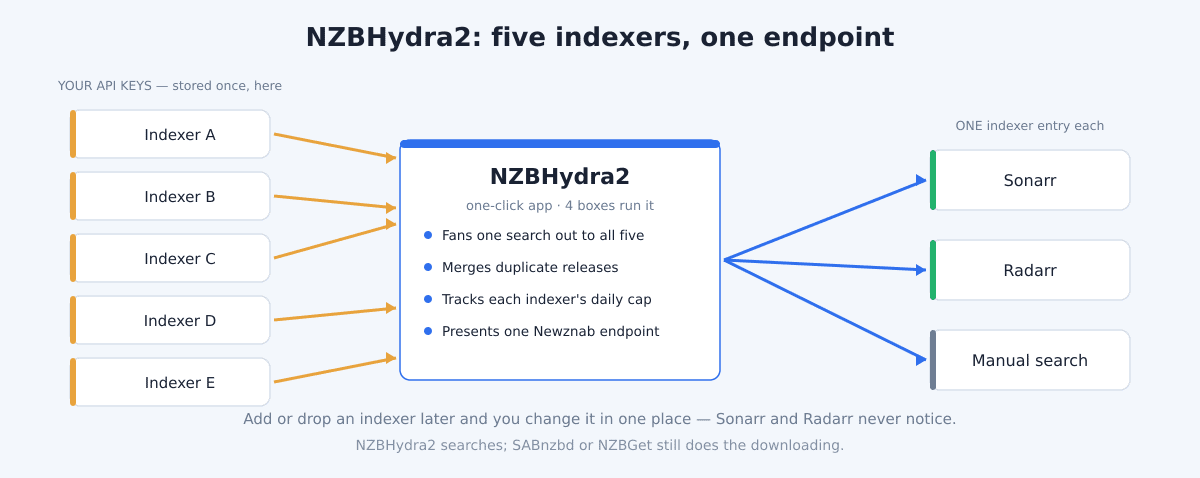
- Search everything at once. One query fans out to every configured indexer in parallel instead of you searching each one by hand.
- Duplicate detection and merging. When three indexers all carry the same release, NZBHydra2 recognizes it and collapses it into a single result, so you’re not scrolling past the same file five times.
- Unified stats and API limit tracking. It tracks how many API hits and downloads you’ve spent against each indexer’s daily cap, in one dashboard. This alone is worth it if you’re constantly bumping into limits.
- One endpoint to configure. Instead of adding five indexers to Sonarr, five to Radarr, and five to your manual search, you add NZBHydra2 once. Add or remove an indexer later and you only change it in NZBHydra2 — the *arr apps never notice.
NZBHydra2 vs Prowlarr: Which One?
This is the honest part. Prowlarr also manages indexers centrally and pushes them out to Sonarr, Radarr, and friends, so there’s real overlap. For a lot of people, Prowlarr alone is enough — it handles both torrent and Usenet indexers and syncs them to your apps automatically. If that describes you, start with our Prowlarr setup guide and our Prowlarr on a seedbox page.
Where NZBHydra2 pulls ahead is aggregation and dedup specifically for Usenet. Prowlarr syncs your indexers as separate entries; NZBHydra2 merges them into one search that deduplicates across all of them and tracks combined API usage. If you run many Usenet indexers and care about not seeing duplicates and not blowing through daily caps, NZBHydra2 is the better fit.
| Use case | Better tool |
|---|---|
| Mix of torrent + Usenet indexers, want simple sync | Prowlarr |
| One or two Usenet indexers, minimal setup | Prowlarr (or nothing) |
| Many Usenet indexers, want dedup + unified caps | NZBHydra2 |
| Want aggregated search across indexers as one endpoint | NZBHydra2 |
They’re not mutually exclusive. A common setup is to run NZBHydra2 as your aggregation layer and point Prowlarr (or your apps directly) at it. Use whichever, or both — NZBHydra2 works alongside or instead of Prowlarr.
What You Need First
Here’s the disclaimer we make on every Usenet guide: EvoSeedbox hosts the automation software, not the Usenet access. NZBHydra2, SABnzbd, NZBGet, Sonarr, and Radarr are all one-click apps on our servers, but they’re empty pipes until you supply the two things we don’t provide:
- A Usenet provider — the service that actually stores and serves the binary articles (your download source and retention).
- At least one Usenet indexer — the search database that produces the NZB files. NZBHydra2 aggregates indexers, so it needs at least one behind it to be useful, and it really shines with several.
If any of that is new to you, read our pillar guide on Usenet on a seedbox first — it covers how providers and indexers fit together. For choosing hardware and unmetered bandwidth for Usenet workloads, see the best seedbox for Usenet breakdown.
Setting Up NZBHydra2 on Your Seedbox
The install itself is trivial on EvoSeedbox — the rest is configuration you’d do on any host.
1. Install the app
Open your dashboard, find NZBHydra2 in the app list, and click install. It provisions behind our authenticated reverse proxy with a URL and login ready to go. No Docker commands, no port juggling. If it ever stops responding, App Doctor detects and self-heals it, and flags anything it can’t fix for us.
2. Add your indexers to NZBHydra2
Inside NZBHydra2, go to Config → Indexers → Add and enter each of your Usenet indexers: its host URL and your personal API key. Repeat for every indexer you own. Run a test search to confirm each one returns results. This is now the only place those API keys live.
3. Point your *arr apps at NZBHydra2 — once
In Sonarr and Radarr, add a single Newznab indexer. For the URL use your NZBHydra2 address, and for the API key use the one NZBHydra2 generates (found under Config → Search). That’s it — one entry replaces the pile of individual indexers you’d otherwise add to each app.
4. Wire up your downloader
NZBHydra2 handles search; SABnzbd or NZBGet does the actual downloading. In your *arr apps, add SABnzbd or NZBGet as the download client so grabbed NZBs get sent there automatically. If you haven’t set the downloader up yet, follow our SABnzbd setup guide or NZBGet setup guide. You can also add NZBHydra2 as a search source within SABnzbd/NZBGet for manual grabs.
Your first search — and the caps that keep you unblocked
Once those four steps are done, two things are worth doing immediately rather than eventually:
- Run a search from NZBHydra2 itself before you trust anything downstream. Search for something you know exists; you should see results from every indexer you added, already deduplicated. If one returns nothing, its API key or host URL is wrong — find that now, not three weeks later when Sonarr has been quietly missing releases.
- Enter each indexer’s real limits under Config → Indexers (hit limit and download limit per day — both are on your indexer’s profile page). NZBHydra2 then stops querying an indexer once it is spent instead of hammering it into a temporary block. This is half the reason to run an aggregator at all, and it is the setting people skip.
- Press Test before Save in Sonarr and Radarr. When you add NZBHydra2 as a Newznab indexer, the URL and API key have to be exactly right. The most common Usenet ticket we handle is an *arr app pointed at a slightly wrong endpoint — every dashboard looks healthy and nothing ever imports. The Test button catches it in two seconds.
- Map your categories so TV results reach Sonarr and film results reach Radarr, rather than both apps sifting everything and occasionally grabbing each other’s releases.
Tips Worth Knowing
- Set per-indexer API caps. Each indexer has a daily hit and download limit. Enter those limits in NZBHydra2 so it stops querying an indexer once it’s exhausted rather than getting you temporarily blocked.
- Use categories consistently. Map NZBHydra2 categories (TV, Movies, etc.) so results are filtered correctly and your *arr apps only see relevant releases.
- Prioritize your indexers. Give your best-retention or unlimited indexers higher priority so NZBHydra2 prefers them when merging duplicates.
- Check the stats page. NZBHydra2’s stats show which indexers actually produce successful downloads. If one never contributes, drop it and free up the API budget.
Frequently Asked Questions
Do I still need Usenet indexers if I use NZBHydra2?
Yes. NZBHydra2 doesn’t have its own release database — it aggregates the indexers you already subscribe to. You need at least one, and it’s most useful when you run several. EvoSeedbox provides the software, not the indexers or Usenet access.
Is NZBHydra2 a replacement for SABnzbd or NZBGet?
No. NZBHydra2 searches and aggregates; SABnzbd and NZBGet download. They do different jobs and you run both — NZBHydra2 finds the NZB, your downloader fetches it.
Should I use NZBHydra2 or Prowlarr?
If you run one or two Usenet indexers, or a mix of torrent and Usenet, Prowlarr alone is usually enough. Choose NZBHydra2 when you run many Usenet indexers and specifically want cross-indexer duplicate merging and unified API-limit tracking. Many people run both, with NZBHydra2 as the aggregation layer.
How many indexers can I add to NZBHydra2?
There’s no practical limit — that’s the point. Whether you have three indexers or a dozen, they still appear to your apps as a single search endpoint, and NZBHydra2 dedupes across all of them.
Is NZBHydra2 hard to set up on a seedbox?
The install is one click on EvoSeedbox, and App Doctor keeps it running. The configuration — adding your indexer API keys and pointing your *arr apps at NZBHydra2 — takes a few minutes. It’s a power-user tool (only a handful of our users run it), but the setup is straightforward once your indexers are in hand.
What if NZBHydra2 goes down?
Our App Doctor system monitors every app and automatically restarts or repairs NZBHydra2 if it becomes unresponsive, escalating to our team anything it can’t self-heal. Your searches route through it, so keeping it healthy is handled for you.
NZBHydra2 turns a tangle of Usenet indexers into one clean, deduplicated search endpoint — and on EvoSeedbox it’s a one-click install backed by self-healing infrastructure. Bring your own Usenet provider and indexers, and we’ll handle the automation stack. Plans start at $5/mo — see EvoSeedbox pricing and get your Usenet setup aggregated today.
{“@context”: “https://schema.org”, “@type”: “FAQPage”, “mainEntity”: [{“@type”: “Question”, “name”: “Do I still need Usenet indexers if I use NZBHydra2?”, “acceptedAnswer”: {“@type”: “Answer”, “text”: “Yes. NZBHydra2 doesn’t have its own release database — it aggregates the indexers you already subscribe to. You need at least one, and it’s most useful when you run several. EvoSeedbox provides the software, not the indexers or Usenet access.”}}, {“@type”: “Question”, “name”: “Is NZBHydra2 a replacement for SABnzbd or NZBGet?”, “acceptedAnswer”: {“@type”: “Answer”, “text”: “No. NZBHydra2 searches and aggregates; SABnzbd and NZBGet download. They do different jobs and you run both — NZBHydra2 finds the NZB, your downloader fetches it.”}}, {“@type”: “Question”, “name”: “Should I use NZBHydra2 or Prowlarr?”, “acceptedAnswer”: {“@type”: “Answer”, “text”: “If you run one or two Usenet indexers, or a mix of torrent and Usenet, Prowlarr alone is usually enough. Choose NZBHydra2 when you run many Usenet indexers and specifically want cross-indexer duplicate merging and unified API-limit tracking. Many people run both, with NZBHydra2 as the aggregation layer.”}}, {“@type”: “Question”, “name”: “How many indexers can I add to NZBHydra2?”, “acceptedAnswer”: {“@type”: “Answer”, “text”: “There’s no practical limit — that’s the point. Whether you have three indexers or a dozen, they still appear to your apps as a single search endpoint, and NZBHydra2 dedupes across all of them.”}}, {“@type”: “Question”, “name”: “Is NZBHydra2 hard to set up on a seedbox?”, “acceptedAnswer”: {“@type”: “Answer”, “text”: “The install is one click on EvoSeedbox, and App Doctor keeps it running. The configuration — adding your indexer API keys and pointing your *arr apps at NZBHydra2 — takes a few minutes. It’s a power-user tool (only a handful of our users run it), but the setup is straightforward once your indexers are in hand.”}}, {“@type”: “Question”, “name”: “What if NZBHydra2 goes down?”, “acceptedAnswer”: {“@type”: “Answer”, “text”: “Our App Doctor system monitors every app and automatically restarts or repairs NZBHydra2 if it becomes unresponsive, escalating to our team anything it can’t self-heal. Your searches route through it, so keeping it healthy is handled for you.”}}]}
